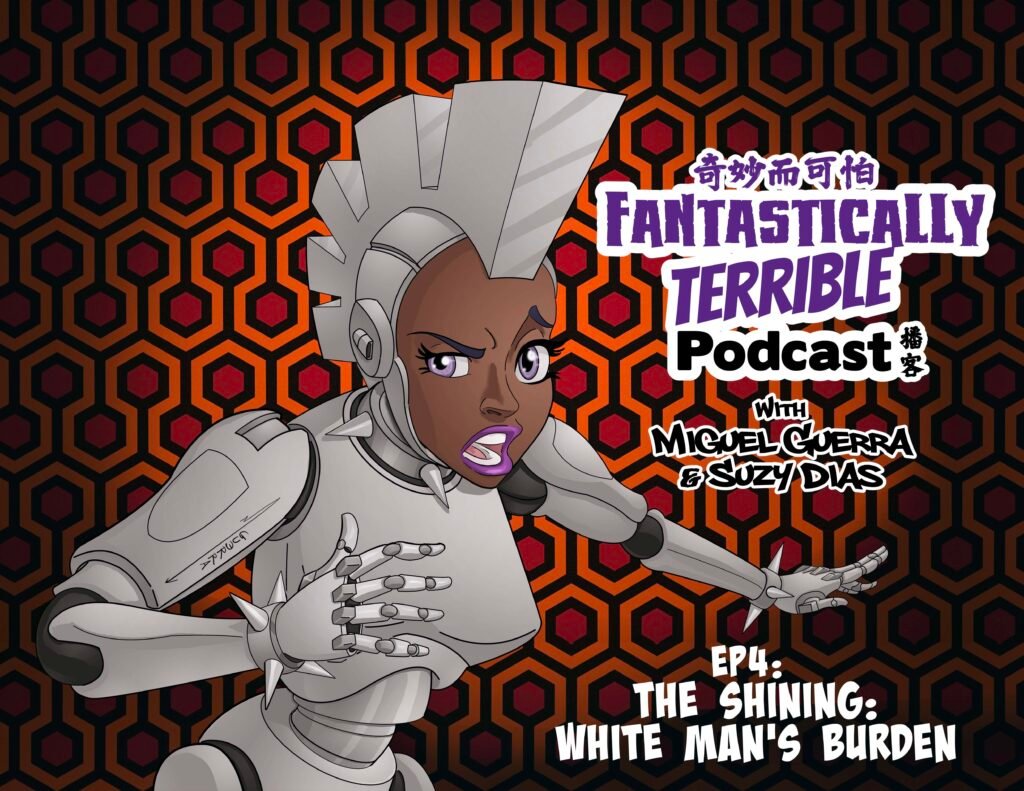
Episode 4: The Shining, White Man’s Burden
Today, we’re looking at the classic horror movie, “The Shining” (1980). It’s such a superb film, that each time we watch it, we find a deeper meaning. This time the “restroom” scene with Delbert Grady and Jack Torrance really slapped us in the face. After doing some digging online, I found an excellent “Scraps from the Loft” interview with Stanley Kubrick’s co-writer, Diane Johnson. We’ll attempt to lay the groundwork for what makes the Overlook Hotel a haunted nightmare and whether or not the ghosts are real or all in Jack’s psychotic mind.
There will be lots of blood, major family dysfunction, ghosts, the collective unconscious, freaky twins and terror! As always, inks to everything we mention on the show are provided at the end of this post.
“My own work with Kubrick in 1979 came about as a result of his reading my novel “The Shadow Knows” (1974), a psychological novel with certain connections to the detective story, in my mind dealing with racial issues and urban violence, or, in the minds of some readers, about the deteriorating state of mind of a young woman under stress who is perhaps, or perhaps not, being stalked. Kubrick had been browsing in the “horror” genre because he wanted, he said, to make the scariest move he could….”
“When it came to the horror film, he did not want to make a movie that depended unduly on ghosts and gimmicks for horrific effect. Though he did not rule out the supernatural, he wanted to create a film in which the horror generated from human psychology. This was the case with my novel and also to some extent with Steven King’s novel “The Shining” (1977); there are some apparitions in the latter that can be taken for projections of the disturbed mind of the hero, Jack Torrance, and are also supernatural. For whatever reason,…Kubrick chose to use The Shining; he did, however, choose me to write the script…”
“For Stephen King, I gather from his remake of “The Shining” (1997), the character flaws of the father were of less interest than the supernatural powers of foresight of Danny, the little boy; and the hotel was the true villain, evil locked in combat with the good child. It was the character of the father that interested Kubrick; the powers of the boy were mainly metaphorical, a child’s heightened sensitivity to the demons rising in the adults who have power over him. To what extent supernatural forces existed and to what extent these were psychological projections was something we discussed at length, finally deciding that the ghosts and magical apparitions at the Overlook Hotel were both, that the supernatural was somehow generated by human psychology, but, once generated, really existed and had power. Could Lloyd, the ghostly caretaker/bartender open a door, for instance to let Jack out of the freezer? Pour him a drink? Hand him a baseball bat? The answer had to be yes.”
“…Kubrick would avail himself of these and other traditional ingredients of horror, for instance the moldering corpse of the woman in the bathtub, which was also in King’s text. But it was typical of Kubrick to want an explanation for the nature of horror, wanting to understand the underlying psychological mechanism but also willing to accept the convention of the supernatural. Thus he wanted a “rational” explanation for the haunting of the hotel; he was drawn to the idea that the place rested on the site of Indian massacres or that building it had desecrated some Native American tombs, with all the ghosts and hauntings summoned thereby. Clearly, he had no objection to the idea of something being haunted, that is, of the supernatural per se, it was just that there had to be a reason for it. He was quite capable of living with the paradox of something being both true and untrue at the same time.” [read the full interview…]. Click here for all of our episodes.