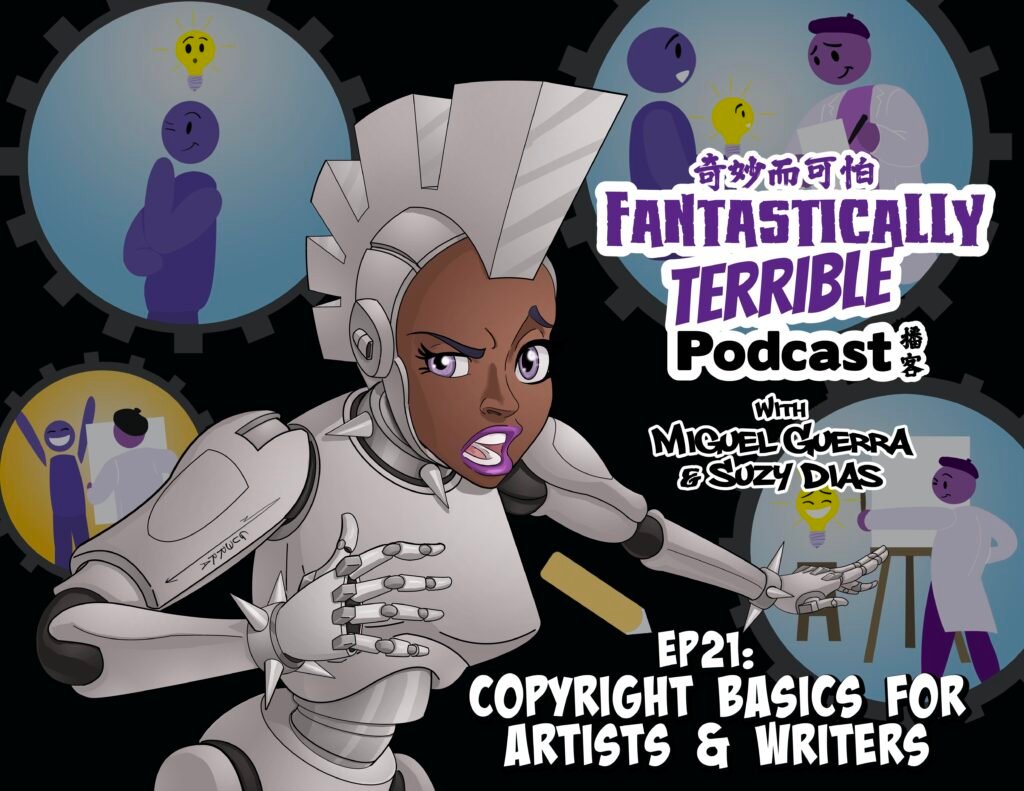
Fantastically Terrible Podcast Ep21: Copyright Basics for Artists & Writers
Is your work automatically copyrighted?
Yes. All original works of authorship (not ideas) that are created for the first time are protected.
What does copyright protect?
Copyright, a form of intellectual property law, protects original works of authorship including literary, dramatic, musical, and artistic works, such as poetry, novels, movies, songs, computer software, and architecture.
Why copyright my work?
If you don’t register, you can’t sue for infringement. Because hey, you never know.
What is not protected?
Copyright does not protect facts, ideas, systems, or methods of operation.
When is my work protected?
Your work is under copyright protection the moment it is created and fixed in a tangible form that it is perceptible either directly or with the aid of a machine or device. This means that whether you wrote it on a computer or with pen and ink it is protected.
I’ve heard about a “poor man’s copyright.” What is it?
The practice of sending a copy of your own work to yourself is sometimes called a “poor man’s copyright.” There is no provision in the copyright law regarding any such type of protection, and it is not a substitute for registration.
How much does it cost to register with the U.S. Copyright Office?
Check with https://www.copyright.gov/about/fees.html for all the most recent fees and to see all of the types of copyright they offer.
Other questions addressed in the podcast:
☆ Why should I register my work if copyright protection is automatic?
☆ Can I sue someone if I am not registered?
☆ What is Prima Facie evidence?
☆ How do I prove infringement?
☆ Is there a difference in damages awarded for registered vs. unregistered works?
☆ Where in the world is US copyright accepted?
☆ If I’m in Europe, can I Copyright my work?
◙▒◙♫ Listen to the full podcast to get all of the information.
Listen here…
🎬 YouTube https://www.youtube.com/7Robotsinc
🎤︎︎ SoundCloud https://soundcloud.com/7robotspodcast
🎧◝(^⌣^)◜ If you enjoyed the show, give us a LIKE and SUBSCRIBE! We truly appreciate our listeners. After all, you don’t have to be here, but you came anyway. So, Hi! Ain’t the universe amazing?
Deep Dive
Pluto’s first 2 appearances:
Learn more…
★ Copyright, Trademark & Right of Publicity Law for Comic Book Creatorby Jack Weatherford
★ How to Officially Copyright a Comic Book
★ Intellectual Property Law Protection of Comics, Cartoons, Anime, and Manga Works
Free comics!